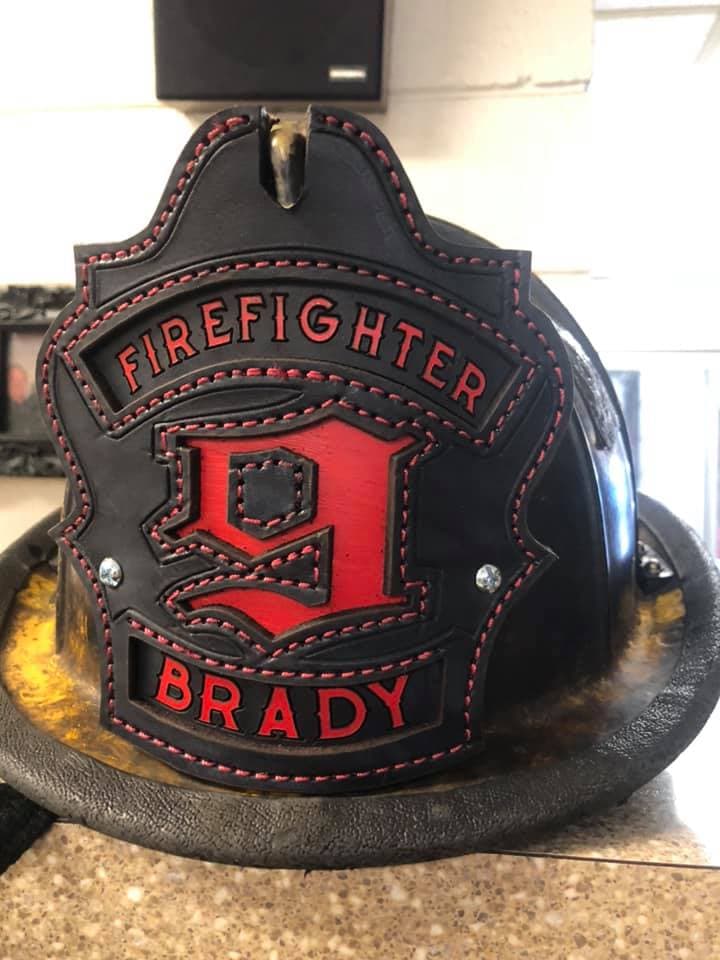
Fire Helmet Shield Anatomy: Rockers, Center, and Everything Explained
Top rocker, bottom rocker, center, bugles, eagle front — every part of a fire helmet shield has a specific name and function. Here's the full vocabulary.

Brian Williams
Captain, KCKFD · Owner, Fire Helmet Shields
If you've ever tried to order a custom fire helmet shield and gotten confused by the terminology — "top rocker," "bottom rocker," "center," "bugles" — you're not alone. Shield design has its own vocabulary that every leather-shield shop uses and almost nobody explains.
Here's a complete glossary of fire helmet shield anatomy, written by somebody who designs and builds them for a living.
The Main Body
The shield itself is the main body — a shaped piece of leather (almost always two layers stacked) mounted to the front of a fire helmet. American shields are typically 6" to 6.75" wide at the widest point and come in several traditional shapes:
- Crew — A classic rounded shape, common across most departments.
- Solo — Similar to Crew but narrower, with a cleaner silhouette.
- Philadelphia diamond — A diamond-shape shield distinctive to Philadelphia FD.
- Kingpin — An FDNY-style traditional front with a distinctive angular cut.
- Passport — A tall, narrow shield favored on traditional leather helmets.
- Classic — A wider, flat-topped shield common on East Coast departments.
- Blackout — A modern matte-black shield with darker styling.
See our full shield collection for visual examples of each shape.
The Top Rocker
The top rocker is the curved strip across the top of the shield where department name or city is traditionally stamped. Examples:
- "FDNY"
- "KANSAS CITY FIRE"
- "AUSTIN FD"
- "MCFRS" (Montgomery County Fire Rescue Service)
On our two-layer leather shields, the top rocker is actually a cutout — the top layer of leather has a curved shape cut out, and the department name is stamped on the second layer below, so the text reads through the opening. This is the traditional construction and gives the shield depth.
The top rocker text is usually the most formal and institutional element — it identifies the firefighter's department to the world.
The Bottom Rocker
The bottom rocker is the curved strip across the bottom of the shield where the firefighter's last name, company number, or service years are stamped. Examples:
- "WILLIAMS"
- "ENGINE 12"
- "1995-2025"
- "CAPT. BROWN"
The bottom rocker is the most personal element — it says who the firefighter is. On retirement shields, it often carries service dates instead of a name.
The Center
The center of the shield is the largest stamped element, positioned between the top and bottom rockers. This is where the primary identifying feature goes:
- Company number: "Engine 12," "Ladder 4," "Rescue 1"
- Rank designation: "CAPT," "CHIEF," "LT"
- Maltese cross: Traditional fire service symbol
- Bugles: Officer rank designators
- Department badge / logo: Custom department artwork
- Eagle: Traditional front-piece eagle (mostly on FDNY-style shields)
The center is where custom design personality happens. Line firefighters typically keep it simple (company number). Officers often add bugles and sometimes Maltese crosses or department logos.
Bugles
Bugles are the officer rank designators — stylized speaking trumpets stamped into the leather. They trace back to the 1800s when fire chiefs used actual speaking trumpets to shout orders over fireground noise. Bugle count by rank:
- 1 bugle — Lieutenant
- 2 bugles (parallel) — Captain
- 2 bugles (crossed) — Battalion Chief
- 3 bugles — Assistant/Deputy Chief
- 4-5 bugles — Fire Chief
Bugles are usually placed above the bottom rocker or flanking the center element. Officers often order promotion shields when they pin on a new rank — see our promotion shields page.
The Eagle Front
The eagle front is a traditional FDNY-style element — a stamped or metal eagle mounted above the top of the shield. On old FDNY leather fronts, the eagle was a separate metal piece attached to the top of the leather. Modern shields often stamp the eagle directly into the leather instead.
Eagle fronts are almost exclusively found on East Coast and FDNY-style shields. West Coast and Midwest departments rarely use them.
Leather Layers and Construction
A proper leather helmet shield has two layers:
- The top layer — Dyed leather in black, brown, red, or white. This is the "face" of the shield. The rockers are cut out as openings.
- The bottom layer — Undyed or contrasting-color leather. Visible through the rocker cutouts, carrying the stamped lettering.
The two layers are machine-stitched together on a Cobra Class 3, a heavy-duty sewing machine built for thick leather, in the stitching color you choose.
All of our shields are built from 9oz vegetable-tanned leather in both layers. For more on construction, see our guide to leather fire helmet shields.
Hardware and Mounting
The back of the shield has mounting hardware that connects it to the helmet:
- Eagle post — A small brass post that goes through a hole in the front of the helmet, secured with a nut inside.
- Leather tab — Some shields have a leather tab that tucks behind the helmet's brass plate.
- Hook-and-eye — Modern composite helmets sometimes use a hook-and-eye or velcro attachment.
Mounting varies by helmet type. Cairns leatherheads, MSA Cairns XF1, Phoenix TL-2, Bullard UST, and Morning Pride helmets all have slightly different mounting systems. For help choosing, see our shield size guide or our installation guide.
Color Combinations
Shield color is a design choice with tradition behind it:
- Black shield, white lettering — Most common, works with every helmet color.
- Black shield, gold lettering — Officer tradition, especially on captain and chief shields.
- Red shield, gold lettering — Officer / ceremonial, often paired with a red helmet.
- Brown shield, white lettering — Traditional, heritage look.
- Antique finish — Aged, retirement-display style.
Design Your Own
Now that you know the vocabulary, designing a shield is straightforward: pick a shape, pick a leather color, pick a lettering color, fill in the top rocker (department), center (company number / rank / Maltese cross), and bottom rocker (last name / service years). Use our shield builder to see the layout before you buy.
Every shield we ship is laser-cut, laser engraved, paint-filled, and machine-stitched by a working firefighter. Custom-built for duty wear, retirement display, or gift occasions.